
 Masculinity, Occupation, and Healthy Behaviors
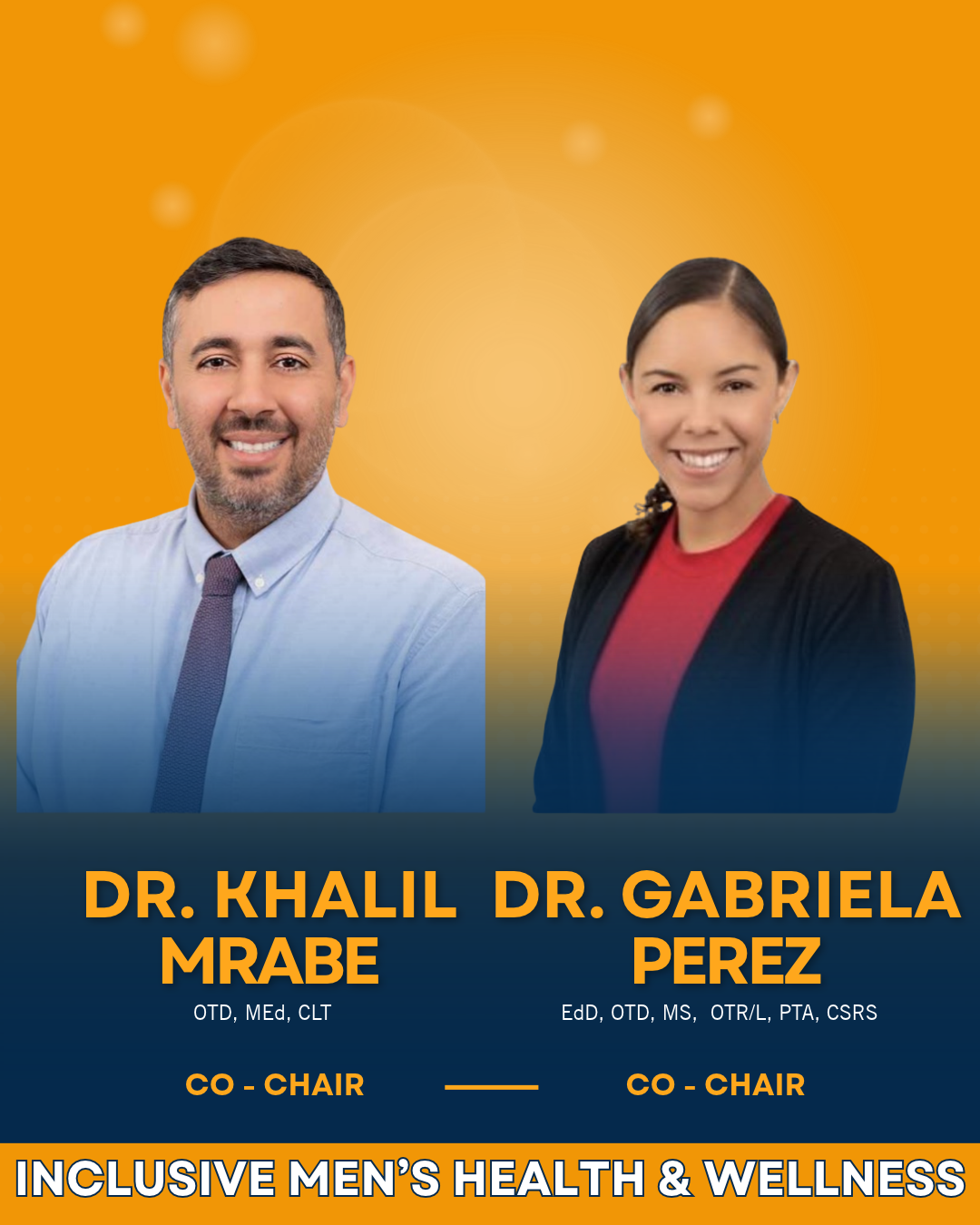
Dr. Khalil Mrabe OTD, Med, CLT
Dr. Gabriela Perez EdD, OTD, MS, OTR/L, PTA, CSRS
Men experience significant health disparities across several areas of health and well-being (Abualhaija N., 2022). However, discourse surrounding men’s health outcomes frequently revolves around disease, mortality, and health behaviors that focus on the utilization of healthcare resources rather than highlighting the everyday occupations that illustrate their lives. This creates a deeply important lens through which occupational therapists can draw meaningful conclusions about men’s health. Additionally, this raises an important question: How do we understand men’s health, not simply as an absence of disease, but rather as the ability to participate in meaningful roles that reflect their underlying value?
Occupational therapy is uniquely positioned to answer this question. The occupational therapy profession supports meaningful participation by examining the ongoing relationship between the individual, occupation, and environment, which either facilitate or inhibit engagement in daily activities (Bass et al., 2024). Through this lens, occupations including but not limited to employment, parenting, exercise, recreation, education, self-care, and social participation are not merely activities on the periphery of health; they are fundamental elements of health itself (Bass et al., 2024). Occupational therapy offers a holistic approach, identifying barriers as well as supports in men’s daily lives by promoting engagement in meaningful roles and routines that contribute to men’s quality of life.
This perspective allows us the opportunity to reconceptualize how we think of men’s health within the field of occupational therapy. Rather than viewing men’s health through the prism of disease, diagnosis, and dysfunction, occupational therapists can reexamine how conditions, occupational demands, environmental contexts, and societal expectations conflate to influence participation, performance, and prosperity throughout the lifespan. Occupational therapy explicitly recognizes health management as an occupation and considers how roles, routines, contexts, and personal factors affect men’s health and well-being (American Occupational Therapy Association [AOTA], 2020). As such, there is a need to reexamine occupation, masculinity, and healthy behaviors.
Across the lifespan, men experience and understand health through the prism of social expectations. Alongside and intertwined with social expectations is the context formulated by perceptions of masculinity (Mahalik et al., 2007). These expectations shape how men view health, illness, vulnerability, and independence. Ultimately shaping the development and maintenance of health behaviors. Beginning early in childhood, experiences and understanding of masculinity may intersect with biological, psychological, social, and environmental factors that shape both health-promoting and health-compromising behaviors. As a socially constructed and continuously evolving concept of manhood, masculinity can influence how, what, when, and why men engage in specific healthcare practices. From an occupational perspective, the influence of masculinity extends beyond individual health behaviors to shape patterns of participation, occupational choice, and the roles men assume across daily life (Beagan & Saunders, 2005). This also includes influencing the occupations and roles through which health is experienced and expressed.
Masculinity influences how men structure their everyday lives. This influence is expressed through the development of occupational roles, rituals, and routines that organize daily life (Beagan & Saunders, 2005). Across the occupational landscape, understanding men’s health requires consideration of health behaviors common in men, but is also reflective of the occupational context in which those behaviors are constructed, reinforced, or limited. The intersection between health, occupation, and engagement presents an opportunity for the occupational therapy profession to contribute to men’s health across the lifespan.
Occupation is central to how people live and experience health. Occupational therapy as a profession is better served by establishing a clear understanding of men’s health beyond their diagnosis. This process should extend beyond establishing a list of occupations to be prescribed as needed. Rather, occupational therapy must redesign occupations by considering the contextual influences that shape occupational choice, engagement, and performance.
Men’s health continues to emerge as a focus within healthcare. However, men’s health continues to be absent in the context of occupational therapy practice and education (Kling et al., 2022). Factors influencing men’s health and how they are addressed are largely overlooked or designed to reinforce commonly held assumptions of male health behaviors. Masculinity is just one contextual factor shaping how men engage in and experience health. Occupational therapy can intervene at the intersection of health, occupation, and environment to create more inclusive opportunities for men and society alike to reorganize our ideas of how we experience health.
References:
Abualhaija N. (2022). Men's health disparities: Causes and interventions. Nursing forum, 57(5), 785–792. https://doi.org/10.1111/nuf.12764
Bass JD, Marchant JK, de Sam Lazaro SL, Baum CM. Application of the Person–Environment–Occupation–Performance Model: A Scoping Review. OTJR: Occupational Therapy Journal of Research. 2024;44(3):521-540. doi:10.1177/15394492241238951
Beagan, B., & Saunders, S. (2005). Occupations of Masculinity: Producing Gender through What Men Do and Don’t Do. Journal of Occupational Science, 12(3), 161–169. https://doi.org/10.1080/14427591.2005.9686559
Kling, J. M., Sleeper, R., Chin, E. L., Rojek, M. K., McGregor, A. J., Richards, L., Mitchell, A. B., Stasiuk, C., Templeton, K., Prasad, J., Pfister, S., & Newman, C. B. (2022). Sex and Gender Health Educational Tenets: A Report from the 2020 Sex and Gender Health Education Summit. Journal of women's health (2002), 31(7), 905–910. https://doi.org/10.1089/jwh.2022.0222
Mahalik, J. R., Burns, S. M., & Syzdek, M. (2007). Masculinity and perceived normative health behaviors as predictors of men's health behaviors. Social science & medicine (1982), 64(11), 2201–2209. https://doi.org/10.1016/j.socscimed.2007.02.035
Occupational Therapy Practice Framework: Domain and Process—Fourth Edition. American Journal of Occupational Therapy. 2020;74(2_suppl):S513-S600. doi:10.5014/ajot.2020.74S2001